CARES Act & 2026 Tax Changes: Small Business Insider Guide

Advertisements
The 2026 small business tax changes mark a major transition for U.S. entrepreneurs as temporary relief measures and key provisions shift.
This guide provides actionable insights into expiring deductions, regulatory adjustments, and strategic financial planning to help small businesses adapt and maintain long-term profitability.
The Legacy of the CARES Act on Small Business Taxation
The Coronavirus Aid, Relief, and Economic Security (CARES) Act, enacted in March 2020, was a monumental piece of legislation designed to provide economic relief during the pandemic.
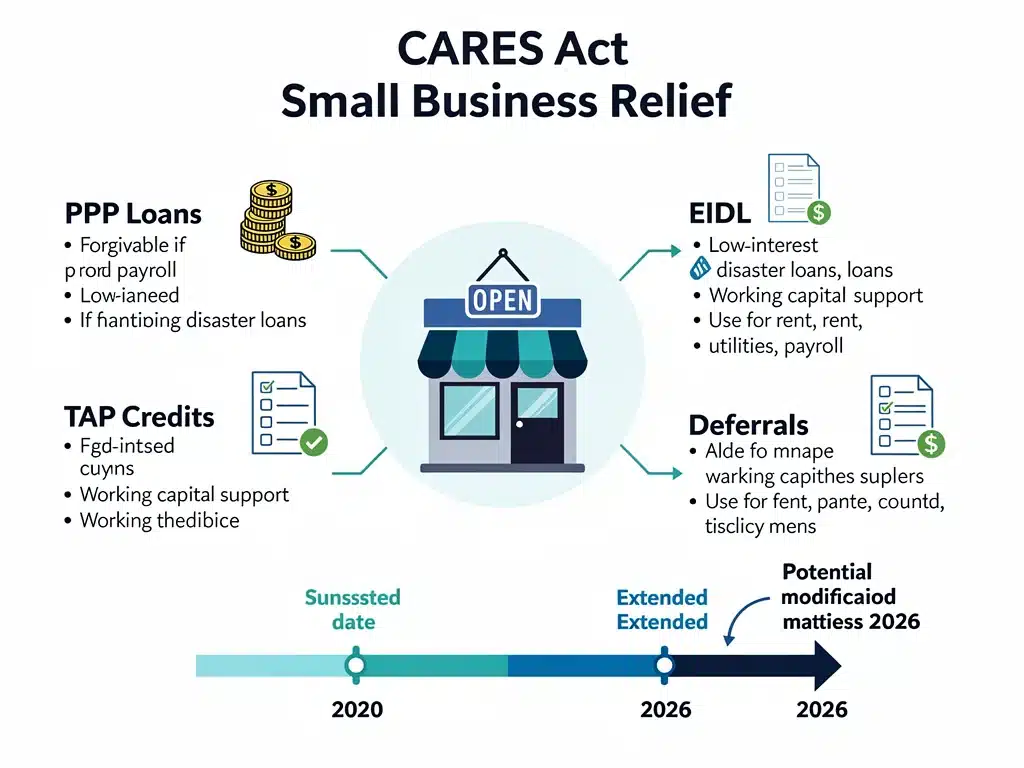
For small businesses, it introduced several critical provisions, including the Paycheck Protection Program (PPP), Economic Injury Disaster Loans (EIDL), and various tax credits.
These measures offered unprecedented support, helping countless businesses navigate closures and economic uncertainty.
Many of these provisions had a direct impact on taxable income, deductions, and credits, fundamentally altering the tax landscape for several years.
Understanding the sunset clauses and expiration dates of these provisions is crucial as we look towards the 2026 small business tax changes.
The immediate relief provided by the CARES Act allowed businesses to retain employees and cover essential operating costs.
This temporary framework also introduced complexities, with businesses needing to meticulously track expenditures and adhere to specific guidelines to qualify for forgiveness and credits.
The approaching deadline for many of these provisions means a return to pre-CARES Act tax structures, or potentially entirely new ones, as part of the broader 2026 small business tax changes.
Key CARES Act Provisions and Their Sunset
Many of the beneficial tax provisions under the CARES Act were not designed to be permanent. Understanding which elements are expiring is the first step in preparing for the 2026 small business tax changes.
- Paycheck Protection Program (PPP) Loan Forgiveness: While the application period has closed, the tax treatment of forgiven PPP loans, generally excluded from gross income, is a significant consideration.
- Employee Retention Credit (ERC): This refundable tax credit for retaining employees during the pandemic has largely expired, but businesses may still be able to claim it for past quarters.
- Deferral of Employer Social Security Taxes: This provision allowed businesses to defer payment of the employer’s share of Social Security taxes, with half due by December 31, 2021, and the remainder by December 31, 2022.
The expiration of these and other temporary relief measures will inevitably reshape the financial planning strategies for small businesses.
The removal of these supports will make the upcoming 2026 small business tax changes feel even more pronounced, necessitating a comprehensive review of current financial models.
Anticipated Broad Tax Reform for 2026
Beyond the expiration of CARES Act provisions, the year 2026 is significant due to the scheduled sunset of many individual income tax provisions from the Tax Cuts and Jobs Act (TCJA) of 2017.
While primarily affecting individuals, these changes have substantial ripple effects on pass-through entities, which constitute a vast majority of small businesses.
The potential for a complete overhaul of the tax code, or at least significant modifications, looms large.
Lawmakers will face pressure to extend certain popular provisions, allow others to expire, or introduce new legislation to address current economic realities.
This makes predicting the exact nature of the 2026 small business tax changes challenging but highlights the need for adaptability.
Discussions around tax reform often involve debates over corporate tax rates, individual income tax brackets, and various deductions.
For small businesses structured as S-corporations, partnerships, or sole proprietorships, these individual-level changes directly impact the owner’s tax liability.
Therefore, monitoring legislative debates closely is crucial for understanding the full scope of the 2026 small business tax changes.
Potential Changes to Individual Income Tax Rates and Deductions
The TCJA significantly altered individual income tax rates, nearly doubled the standard deduction, and modified various itemized deductions.
As these provisions are set to expire, several scenarios could unfold impacting 2026 small business tax changes.
- Return to Pre-TCJA Tax Brackets: Without legislative action, individual income tax rates could revert to higher pre-2018 levels, directly affecting pass-through business owners.
- Standard Deduction Reduction: The standard deduction could decrease, potentially pushing more taxpayers to itemize, though overall impact on small businesses varies.
- Qualified Business Income (QBI) Deduction (Section 199A): This deduction allows eligible pass-through entities to deduct up to 20% of their qualified business income. Its expiration would significantly increase the tax burden for many small business owners.
The fate of these key provisions will determine much of the financial landscape for small businesses.
Any increase in individual tax rates or the elimination of deductions like QBI would necessitate a re-evaluation of pricing strategies, compensation structures, and overall profitability.
Preparing for these potential shifts is a key component of navigating the 2026 small business tax changes effectively.
Impact on Pass-Through Entities and Sole Proprietors
A significant portion of small businesses in the United States operate as pass-through entities, meaning their profits and losses are passed through directly to the owners’ personal income tax returns.
This includes sole proprietorships, partnerships, and S-corporations.
Therefore, any modifications to individual income tax rates, deductions, or credits directly translate into changes for these businesses.
The potential expiration of the Qualified Business Income (QBI) deduction, in particular, could have a profound effect, as it has been a major tax benefit for many small business owners since its inception under the TCJA.
The 2026 small business tax changes will disproportionately impact these entities.
Understanding how these changes will manifest is crucial for strategic planning. Businesses may need to reconsider their legal structure, evaluate their profit distribution strategies, and adjust their overall financial forecasts.
Proactive engagement with tax professionals will be essential to model different scenarios and prepare for the most impactful 2026 small business tax changes.
Navigating QBI Deduction Expiration
The Section 199A QBI deduction has been a cornerstone of tax planning for many pass-through businesses. Its scheduled expiration in 2025 means that it will no longer be available for the 2026 tax year unless Congress acts to extend it.
- Increased Taxable Income: Without the QBI deduction, the taxable income for many small business owners will increase, leading to higher overall tax liabilities.
- Strategic Planning Adjustments: Businesses that have relied heavily on this deduction will need to adjust their financial models and potentially explore other tax-saving strategies.
- Potential for Legislative Action: While currently set to expire, there is always a possibility that Congress could extend or modify the QBI deduction, making ongoing monitoring crucial.
The absence of the QBI deduction would require small businesses to re-evaluate their operational expenses, investment strategies, and even their compensation structures to mitigate the increased tax burden.
The impending 2026 small business tax changes, especially concerning QBI, demand immediate attention and forward-thinking strategies.
State and Local Tax Implications in 2026
While federal tax law changes often garner the most attention, it is equally important for small business owners to consider the evolving landscape of state and local taxation.
Many states align their tax codes with federal provisions, meaning federal changes can trigger corresponding adjustments at the state level.
Furthermore, states are increasingly exploring new revenue streams, which could include new taxes or changes to existing ones that impact businesses.
These state and local developments, combined with the federal 2026 small business tax changes, create a complex web of regulations that small businesses must navigate.
Staying informed about both federal and state legislative sessions is therefore essential.
The interplay between federal, state, and local tax laws can be incredibly intricate, creating compliance challenges for businesses operating across different jurisdictions.
A change at one level can have cascading effects, potentially altering tax liabilities, reporting requirements, and even business operational costs.
This multi-layered approach to taxation means that the 2026 small business tax changes are not just a federal issue but a comprehensive challenge.
Understanding SALT Deduction Limitations
The TCJA imposed a $10,000 cap on the deduction for state and local taxes (SALT) for individual taxpayers, including those who own pass-through businesses. This limitation has been a contentious issue, particularly in high-tax states.
- Potential Expiration of the Cap: If the SALT cap expires along with other TCJA provisions, it could significantly benefit small business owners in states with high property and income taxes.
- State-Level Workarounds: Some states have introduced workarounds, such as Pass-Through Entity (PTE) taxes, to allow businesses to effectively bypass the federal SALT cap.
- Varying Impact by Location: The impact of the SALT cap’s expiration or extension will vary significantly depending on the state in which a business operates and the owner’s individual tax situation.
The future of the SALT deduction limitation is a key component of the broader 2026 small business tax changes.
Its resolution will have direct financial implications for many small business owners, particularly those in states with higher tax burdens.
Businesses should consult with tax advisors to understand how these potential changes could affect their specific circumstances.
Strategic Planning and Preparation for 2026
Given the significant potential for change, proactive strategic planning is non-negotiable for small business owners. Waiting until 2026 to react to new tax laws could lead to missed opportunities or unexpected financial burdens.
Early preparation allows businesses to adapt their financial strategies, operational models, and investment decisions to optimize their tax position.
This preparation should involve a thorough review of current financial statements, a detailed understanding of how existing tax provisions impact the business, and scenario planning for various legislative outcomes.
Engaging with qualified tax professionals and financial advisors is critical to developing a robust strategy that accounts for the complexities of the 2026 small business tax changes.
Developing a flexible financial plan that can adapt to different legislative outcomes is key. This might involve stress-testing various scenarios, such as the expiration of the QBI deduction or changes in individual tax rates.
The goal is to build resilience and ensure the business is well-positioned to thrive regardless of the specific nature of the 2026 small business tax changes.
Key Steps for Proactive Tax Planning
Small businesses can take several concrete steps now to prepare for the impending tax reforms. These actions can help mitigate risks and identify potential advantages.
- Review Business Structure: Evaluate if your current business structure (e.g., sole proprietorship, S-corp, C-corp) remains the most tax-efficient given potential changes to individual and corporate tax rates.
- Optimize Deductions and Credits: Ensure you are maximizing all available deductions and credits under current law, and prepare for potential changes to these provisions.
- Cash Flow Analysis: Conduct a comprehensive cash flow analysis to understand how potential increases in tax liability could impact your business’s liquidity and operational capacity.
These proactive measures will help small business owners navigate the uncertainties surrounding the 2026 small business tax changes.
By taking control of their financial planning now, businesses can minimize surprises and position themselves for continued growth and stability.
The Role of Technology in Tax Compliance and Planning
In an environment of evolving tax laws, technology plays an increasingly vital role in helping small businesses manage compliance and optimize their tax strategies.
Accounting software, tax preparation platforms, and financial analytics tools can streamline processes, reduce errors, and provide valuable insights.
Automating aspects of bookkeeping and tax reporting can free up valuable time and resources, allowing business owners to focus on strategic growth rather than manual compliance tasks.
Furthermore, sophisticated software can help model the impact of various tax scenarios, aiding in proactive planning for the 2026 small business tax changes.
Embracing these technological solutions is no longer a luxury but a necessity for efficient tax management.
The right technology can also enhance accuracy, ensuring that all deductions are claimed and all regulations are met. Cloud-based solutions, in particular, offer accessibility and real-time data, which are crucial for dynamic tax planning.
As the complexity of tax law increases with the 2026 small business tax changes, leveraging technology becomes an indispensable tool for maintaining compliance and financial health.
Leveraging AI and Data Analytics for Future Tax Strategy
Emerging technologies like artificial intelligence (AI) and advanced data analytics are beginning to transform tax planning for small businesses. These tools offer capabilities beyond traditional software.
- Predictive Modeling: AI can analyze vast datasets to predict potential tax liabilities under different legislative scenarios, helping businesses anticipate the impact of the 2026 small business tax changes.
- Automated Compliance Checks: AI-powered tools can automatically review transactions for compliance with current and upcoming tax regulations, reducing the risk of penalties.
- Personalized Tax Advice: While not replacing human experts, AI can provide personalized recommendations based on a business’s specific financial data and industry benchmarks.
Integrating these advanced technologies into a business’s financial operations can provide a significant competitive advantage.
By offering deeper insights and automating complex tasks, AI and data analytics can empower small businesses to navigate the intricate landscape of the 2026 small business tax changes with greater confidence and efficiency.
Seeking Expert Guidance: Accountants and Tax Lawyers
The complexities of the CARES Act’s legacy and the impending 2026 small business tax changes underscore the critical importance of seeking expert guidance.
While technology can aid in compliance, the nuanced interpretation of tax law and the development of bespoke strategies require the expertise of qualified accountants and tax lawyers.
These professionals can provide invaluable insights into how specific legislative changes will impact a particular business, help identify potential tax-saving opportunities, and ensure full compliance with evolving regulations. Their forward-looking advice is crucial for developing a comprehensive strategy that goes beyond mere compliance to foster long-term financial health. Relying on their expertise can save significant time and money in the long run.
A knowledgeable tax advisor can help businesses understand the implications of different legal structures, investment decisions, and operational changes in light of the new tax environment.
They can also represent businesses during audits or disputes, providing peace of mind.
The investment in expert guidance for the 2026 small business tax changes is an investment in the future stability and growth of the business.
When to Engage with Tax Professionals
Engaging with tax professionals should not be a reactive measure taken only when tax season arrives. Proactive consultation is far more beneficial, especially with significant changes on the horizon.
- Early Planning for 2026: Begin discussions now to understand potential impacts of the 2026 small business tax changes and develop a multi-year tax strategy.
- Evaluating Business Decisions: Consult before making major business decisions, such as expanding, acquiring assets, or changing legal structure, to understand the tax implications.
- Ongoing Compliance Review: Regular check-ins can ensure ongoing compliance and help identify new opportunities or risks as tax laws continue to evolve.
Building a strong relationship with a trusted tax advisor is an asset for any small business.
Their expertise will be indispensable in navigating the complexities of the 2026 small business tax changes and ensuring the business remains on a sound financial footing.
| Key Change Area | Brief Description of Impact |
|---|---|
| CARES Act Expirations | Loss of temporary tax benefits like PPP tax exclusion and ERC. |
| TCJA Individual Sunsets | Potential return to higher individual tax rates, affecting pass-throughs. |
| QBI Deduction | Scheduled expiration could significantly increase taxable income for many small businesses. |
| State & Local Taxes | Federal changes may trigger state-level adjustments; SALT cap expiration possible. |
Frequently Asked Questions About 2026 Tax Changes
The main changes anticipated include the expiration of several CARES Act provisions and individual income tax provisions from the TCJA, such as the Qualified Business Income (QBI) deduction. These changes could lead to higher tax liabilities for many pass-through businesses unless Congress acts to extend current laws.
The QBI deduction, which allows eligible pass-through entities to deduct up to 20% of their qualified business income, is set to expire. If not extended, its absence will directly increase the taxable income for many small business owners, potentially leading to a higher overall tax burden on their personal returns.
Businesses should review their current financial structures, conduct cash flow analyses, and engage with tax professionals for scenario planning. Evaluating business structure, optimizing current deductions, and staying informed about legislative developments are crucial for proactive preparation and risk mitigation.
Yes, federal tax law changes often have ripple effects on state and local tax codes, as many states align their regulations with federal provisions. Additionally, the potential expiration of the federal SALT cap could significantly impact businesses and owners in high-tax states, requiring vigilance at all levels.
Technology, including accounting software, tax preparation platforms, and AI-powered analytics, can streamline compliance, reduce errors, and offer predictive insights. These tools assist in modeling different tax scenarios, automating reporting, and providing personalized advice, making tax management more efficient and accurate amidst evolving regulations.
Looking Ahead: Navigating the New Tax Landscape
The impending 2026 small business tax changes represent a significant inflection point for entrepreneurs across the United States.
The sunset of CARES Act provisions and key TCJA elements will usher in a new era of taxation, demanding careful attention and proactive planning.
While the exact contours of the new tax landscape are still taking shape, the message for small business owners is clear: prepare now.
To review key updates, standard deduction adjustments, and legislative shifts for small business filers, see TurboTax’s breakdown of tax changes for the 2026 tax year.
By understanding the potential impacts, leveraging technology, and seeking expert guidance, small businesses can transform what might seem like a daunting challenge into an opportunity for strategic recalibration and sustained growth.
The ability to adapt and pivot will be a defining characteristic of successful businesses in the post-2025 tax environment.
Staying informed about legislative developments and engaging in continuous financial review will be paramount.
The proactive measures taken today will undoubtedly shape the financial resilience and competitive edge of small businesses as they navigate the complexities introduced by the 2026 small business tax changes.


